
The Smart Energy Council has urged the Australian Government to resolve the suspension of its national solar panel recycling pilot, warning that delays are holding back investment and the development of a domestic recycling industry.
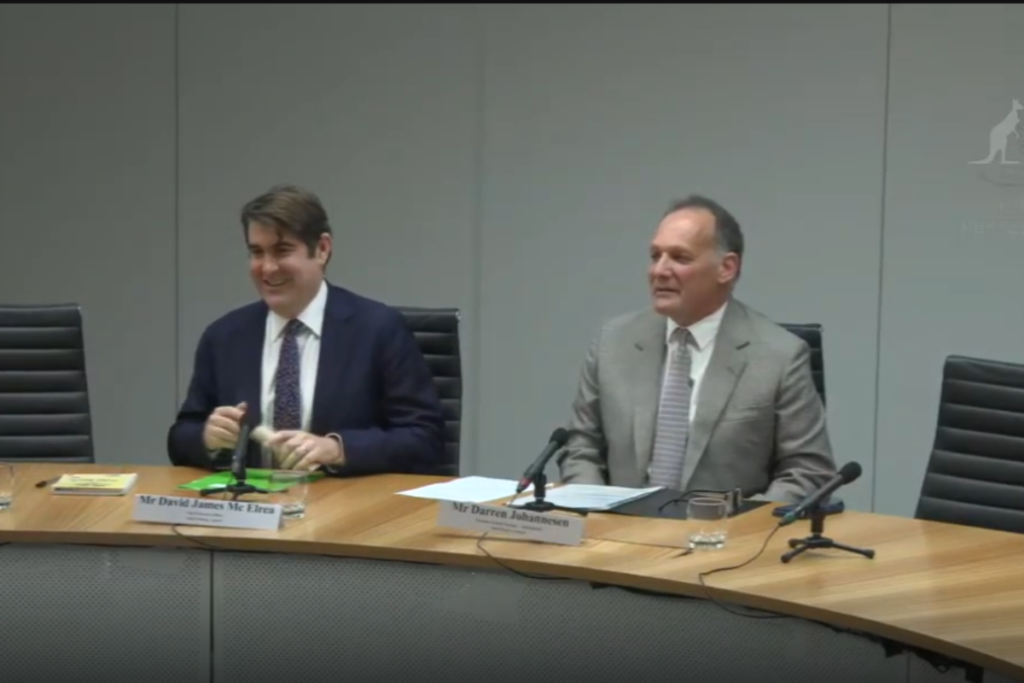
CEO David McElrea and Executive General Manager for Sustainability Darren Johannesen appeared today before the House Standing Committee inquiry into solar panel reuse and recycling in Australia.
In his opening statement, Mr McElrea reaffirmed the Council’s support for a mandatory national solar panel recycling scheme. He said the $24.7 million pilot, announced in January, was intended to help inform a permanent scheme by testing the collection of approximately 250,000 panels through up to 100 sites.
See the full opening remarks below:
The pilot’s procurement process was suspended in May while a complaint was investigated. The Smart Energy Council was among the organisations that tendered for the work.
Mr McElrea said any complaint must be properly investigated and made no comment on its merits. However, he urged the department to decide whether the existing procurement could proceed or a new tender was required.
“Not making a decision is itself a decision,” Mr McElrea told the committee.
He said businesses had invested in staff, equipment and recycling capacity on the expectation that the pilot would proceed.
“That capacity is now sitting idle, while panels continue to reach the end of their working life across households, commercial sites and large-scale projects, many ending up in landfill,” Mr McElrea said.
Committee members questioned how a national scheme would pay to recycle panels already installed. Mr Johannesen outlined the Council’s proposal for a mandatory product stewardship scheme, funded when panels are imported or manufactured, with the cost of older panels included from the outset.
Mr McElrea cautioned that charging only when panels are discarded could encourage illegal dumping. He said a national scheme would also be simpler to implement consistently than separate disposal arrangements across states and local governments.
The hearing examined the cost of transporting heavy panels across Australia. Mr McElrea said the pilot could help determine where collection and logistics hubs should be located, with the potential to support recycling and manufacturing jobs in regional areas, including the Illawarra and Hunter.
Looking ahead, Mr Johannesen highlighted the need to trace panels from installation through removal, collection and recycling. Knowing the origin of recovered materials could help Australian manufacturers demonstrate their use of recycled content and strengthen the market for those materials.
Mr McElrea said a thriving domestic recycling industry could create good jobs and give Australia the opportunity to share its recycling knowledge and skills internationally. But businesses need certainty to make that investment.
The Smart Energy Council will continue working with its members, industry and governments to get the pilot moving and deliver a national scheme that recovers valuable materials, supports regional jobs and gives businesses the confidence to grow.
ENDS.
Media Contact: Tim Lamacraft, GM Media and Comms, media@smartenergy.org.au