
27.10.2026
Australia’s renewable energy industry has reacted with dismay to yesterday’s announcement by the Liberal and National parties that they would axe the hugely popular Cheaper Home Batteries Program.
The Smart Energy Council says the Coalition’s proposal threatens a program that is delivering substantial cost-of-living relief to millions of Australian households and businesses, reducing electricity costs across the grid, strengthening energy security and supporting thousands of Australian jobs.
Smart Energy Council Chief Executive David McElrea said the announcement was particularly disappointing given the overwhelming evidence of the program’s success.
“This is a cost-of-living scheme, not a green scheme. One that’s helping Australian families and businesses permanently reduce their electricity bills, take control of their energy supply and protect themselves against rising energy costs.”
“The Coalition says it wants to tackle the cost of living by scrapping a program that’s saving money for millions of Australians.”
Since its introduction in July 2025, the program has helped over a million Australian households, businesses and community facilities install batteries.
The latest figures from the Australian Energy Market Operator, released on Friday, show wholesale electricity prices fell by 27 per cent compared with the same quarter last year, with growing battery capacity significantly contributing to lower evening peak prices for all consumers.
“The evidence is now overwhelming. Batteries are delivering lower electricity costs, a more reliable grid and greater energy security for Australians,” Mr McElrea said.
The benefits of the Cheaper Home Batteries Program are clear:
- Lower power bills for households with batteries: Households can store their cheap rooftop solar electricity and use it at night rather than buying expensive electricity from the grid. The ACCC has found households with solar and batteries have annual electricity bills between $329 and $909 lower than households relying entirely on grid electricity.
- Lower electricity costs for everyone, including households without batteries: Home batteries reduce demand for expensive grid electricity during evening peaks, helping push down electricity prices, with AEMO showing wholesale prices down a third in the last quarter. These savings flow through to lower bills for all electricity consumers.
- A more stable and reliable electricity grid: Batteries reduce pressure on the electricity network when demand is highest, helping reduce the risk of blackouts. AEMO found households with solar and batteries drew around 75 per cent less electricity from the grid during evening peaks than households with solar alone.
- Greater household energy security and independence: Batteries give Australians more control over when and how they use electricity, reducing their dependence on energy retailers and volatile energy markets. Appropriately configured batteries can also provide backup electricity during blackouts.
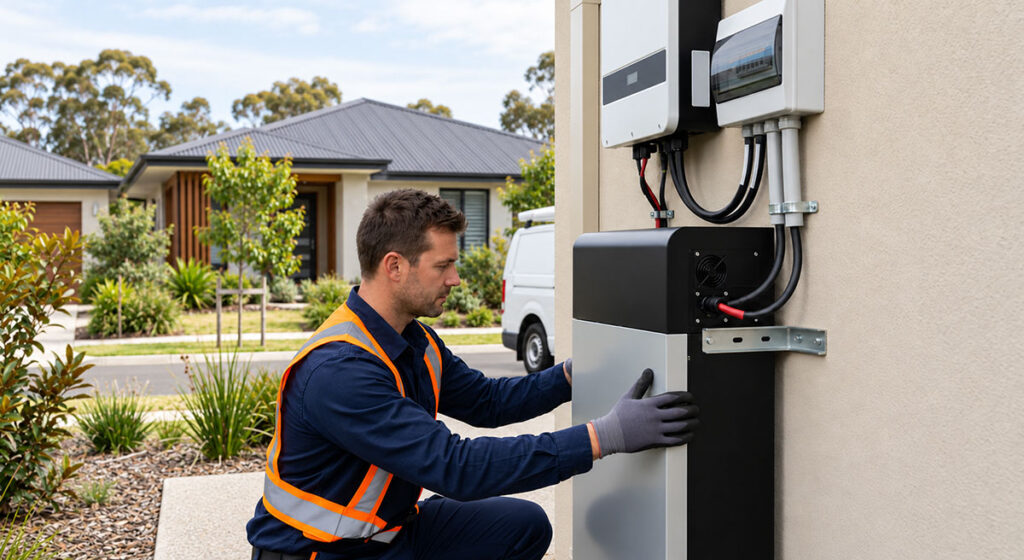
- Thousands of Australian jobs: The number of accredited battery installers across Australia has doubled to 8,846 since the program commenced – supporting thousands of small electrical businesses and sub-contractors in suburban and regional communities.
In just three and a half years, 26,826 apprentices have commenced training through the clean energy stream of the New Energy Apprenticeship program. Scrapping home battery incentives directly jeopardises their career pathways and job security.
- Less carbon pollution: Batteries allow more clean Australian solar energy to be used when it is needed, reducing reliance on unreliable coal and gas generation and helping cut emissions from the electricity system.
- Making household energy independence more affordable: The program provides an upfront discount of around 30 per cent on eligible home batteries, putting the technology within reach of more Australian families and small businesses.
- Overwhelming public support: Smart Energy Council polling conducted by YouGov found that 75 per cent of Australians support the Cheaper Home Batteries Program, while 66 per cent agree that helping households install batteries is a good use of public money.
“Very few government programs deliver such a wide range of practical benefits,” Mr McElrea said.
“The battery program permanently saves families and businesses money. It reduces electricity costs for people who don’t own a battery. It makes our electricity system more reliable. It supports thousands of skilled Australian jobs. And it happens to reduce carbon pollution as well.”
“Catastrophic climate events in the next two summers will highlight the need to reduce decades of excessive carbon pollution.”
“With three in four Australians supporting this program, it is clear that households understand the benefits.”
“In turn it’s supporting 9,000 accredited battery installers – that’s local sparkies, tradies, apprentices, and small family businesses.”
“Public investment needs to be weighed against the substantial and lasting benefits it delivers to Australian families, workers, the economy and our electricity system.”
“The benefits far outweigh the cost of the program, and we urge the Liberal and National parties to work with industry and business to better understand its enormous value, so they can reconsider their hostility.”
“This is fundamentally about the cost of living, not climate politics. Australians deserve access to cheaper electricity, greater energy security and more control over their power bills.”
ENDS –
Media contact: media@smartenergy.org.au | 0448 972 192
ENDS.
Media Contact
Email: media@smartenergy.org.au
Phone: +61 448 972 192
Website: www.smartenergy.org.au
About the Smart Energy Council
The Smart Energy Council is the peak independent membership body representing Australia’s renewable energy industry. We are a not-for-profit organisation and registered charity, advocating on behalf of our members and the wider industry for strong energy policy, increased investment, energy security and sustainable industry growth. Our work spans residential, commercial and industrial distributed energy resources (DER), including solar PV and battery storage, rooftop solar, electrification, electric vehicles and smart transport, renewable manufacturing, large-scale renewable energy, electricity grid development and emerging energy technologies. We represent our members’ interests nationally and internationally, including across the Asia-Pacific region.
If your organisation operates in the renewable energy sector, become a member to support our work, strengthen our collective voice and help shape the industry’s future.
Join renewable energy leaders at our conferences, exhibitions and networking events. Explore upcoming events.