
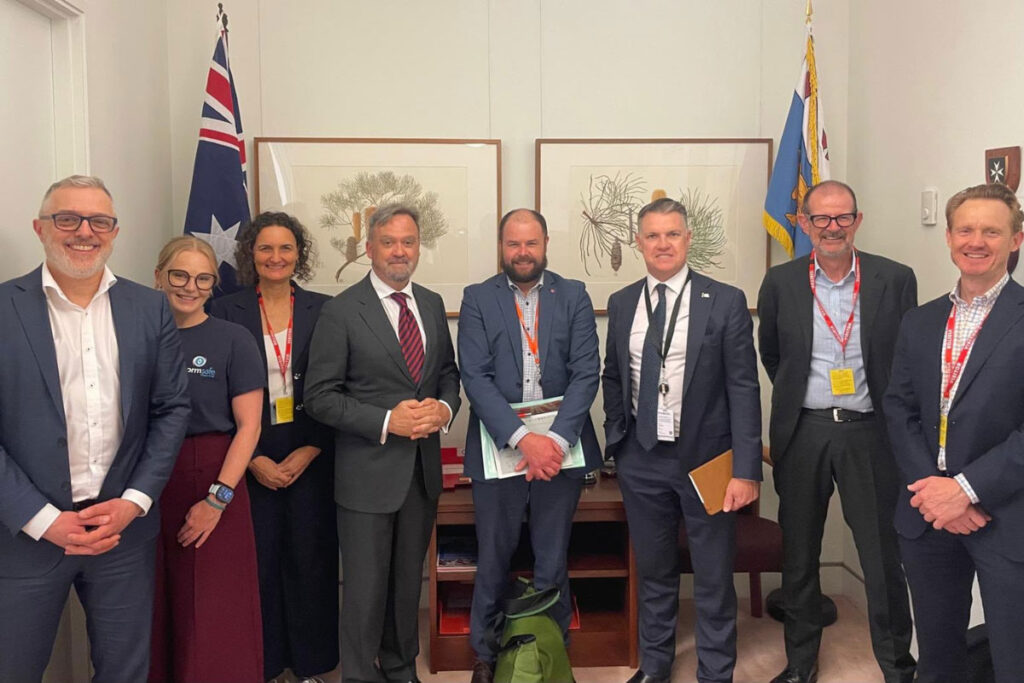
The Smart Energy Council has taken the renewable energy industry’s priorities directly to Parliament House, with CEO David McElrea and Head of Advocacy and Policy, Robert Potter in Canberra meeting with parliamentarians, political offices and industry representatives.
Across the two days, the Smart Energy Council advocated on behalf of its members and the broader renewable energy sector, with discussions covering commercial and industrial solar and storage, freight electrification, the growing energy needs of data centres, investment and project delivery, and the broader role of renewable energy and electrification in Australia’s economy.
The engagement included meetings with politicians and representatives from the Prime Minister’s Office, as well as Rob’s participation in a Clean Capital Forum delegation meeting representatives from across the political spectrum.
The message throughout the visit was consistent: renewable energy and electrification are already delivering benefits for Australian households, businesses and communities, and industry needs clear, practical policy settings to support the next phase of deployment.
Taking our members’ voice directly to Parliament
During his time at Parliament House, Smart Energy Council CEO David McElrea met with politicians and senior representatives to discuss the priorities, opportunities and challenges being raised by members across Australia’s renewable energy industry.
The discussions provided an opportunity to reinforce the contribution renewable energy, storage and electrification are making to jobs, investment, economic growth and Australia’s energy security, while also highlighting areas where industry needs government support to remove barriers and unlock further investment.
David said ensuring industry had a direct voice in national policy discussions was a fundamental part of the Smart Energy Council’s advocacy role.
“Our members’ concerns, priorities and opportunities need to be at the heart of these conversations. We’re here at Parliament House to make sure the renewable energy industry’s voice is heard and that the benefits of renewable energy and electrification for Australia remain front and centre.”
~ David McElrea, CEO, Smart Energy Council
David also recorded an update from Parliament House outlining the purpose of the visit and the importance of taking the industry’s priorities directly to decision-makers.
Watch David’s update from Parliament House
Clean Capital Forum delegation
Alongside David’s meetings, Robert Potter represented the Smart Energy Council as part of the Clean Capital Forum delegation in Canberra.
The delegation met parliamentarians and policymakers to discuss practical measures that can accelerate renewable energy deployment, unlock investment and strengthen Australia’s energy system.
The conversations focused on several areas where policy decisions today will play an important role in determining the pace and scale of future investment.
Unlocking commercial and industrial solar and storage
A major focus was the significant untapped potential of commercial and industrial solar and battery storage.
While rooftop solar is already well established across Australian households, there remains considerable opportunity across warehouses, factories, shopping centres, offices and other commercial premises.
These sites often have large roof areas and substantial daytime electricity demand, making them well suited to solar generation and increasingly to battery storage.
Greater deployment of C&I solar and batteries can help businesses manage electricity costs, improve energy resilience and add significant distributed generation and storage capacity to the electricity system.
The Smart Energy Council continues to advocate for policy and regulatory settings that make it easier for businesses to invest, including addressing barriers associated with grid connections, approvals and project economics.
Accelerating freight electrification
The Canberra discussions also highlighted the need to prepare Australia for the electrification of freight and heavy transport.
The shift to electric trucks and commercial vehicles requires more than bringing new vehicles into the Australian market. It will also require coordinated investment in charging infrastructure, electricity networks, renewable generation and storage.
Depots and major freight routes will need access to sufficient electrical capacity, while businesses need confidence that infrastructure and policy settings will be in place when they make long-term fleet investment decisions.
The Smart Energy Council has been advocating for a coordinated approach that brings together transport, energy and infrastructure planning so Australia can capture the economic and productivity opportunities associated with freight electrification.
Powering the growth of data centres
The rapid expansion of data centres and digital infrastructure was another important area of discussion.
Data centres can require very large amounts of electricity, creating both challenges and opportunities for Australia’s energy system.
As investment in artificial intelligence, cloud computing and digital services grows, planning for this additional electricity demand will become increasingly important.
The Smart Energy Council is advocating for stronger alignment between new data centre development and investment in additional renewable generation, battery storage, transmission and other supporting infrastructure.
Matching new large-scale electricity demand with additional renewable energy capacity can help support continued investment in digital infrastructure while reducing pressure on the existing electricity system.
Unlocking investment and getting projects built
The delegation also discussed the broader conditions needed to turn Australia’s strong pipeline of renewable energy and storage proposals into operating projects.
Renewable energy projects can face lengthy development processes involving planning approvals, grid connections, financing, environmental assessment and infrastructure requirements.
Improving coordination between governments, regulators, network businesses and industry can help reduce unnecessary delays while maintaining appropriate environmental, community and planning standards.
Greater policy certainty is also critical for attracting the long-term investment required for renewable generation, storage, electrification and emerging technologies.
For the Smart Energy Council, the focus is on creating conditions that allow good projects to move from proposal to construction more efficiently and give investors greater confidence in Australia as a destination for renewable energy investment.
Continuing engagement across Parliament
The Canberra visit formed part of the Smart Energy Council’s ongoing engagement with policymakers across the political spectrum.
By bringing the experiences and priorities of members directly into these conversations, the Smart Energy Council will continue advocating for practical policies that support renewable energy deployment, electrification, investment, energy security and a stronger Australian economy.
As Australia’s energy system continues to evolve, maintaining direct engagement between industry and decision-makers will remain central to ensuring policy reflects the opportunities and challenges being experienced on the ground.
Media Contact
Email: media@smartenergy.org.au
Phone: +61 448 972 192
Website: www.smartenergy.org.au
About the Smart Energy Council
The Smart Energy Council is the peak independent membership body representing Australia’s renewable energy industry. We are a not-for-profit organisation and registered charity, advocating on behalf of our members and the wider industry for strong energy policy, increased investment, energy security and sustainable industry growth. Our work spans residential, commercial and industrial distributed energy resources (DER), including solar PV and battery storage, rooftop solar, electrification, electric vehicles and smart transport, renewable manufacturing, large-scale renewable energy, electricity grid development and emerging energy technologies. We represent our members’ interests nationally and internationally, including across the Asia-Pacific region.
If your organisation operates in the renewable energy sector, become a member to support our work, strengthen our collective voice and help shape the industry’s future.
Join renewable energy leaders at our conferences, exhibitions and networking events. Explore upcoming events.