
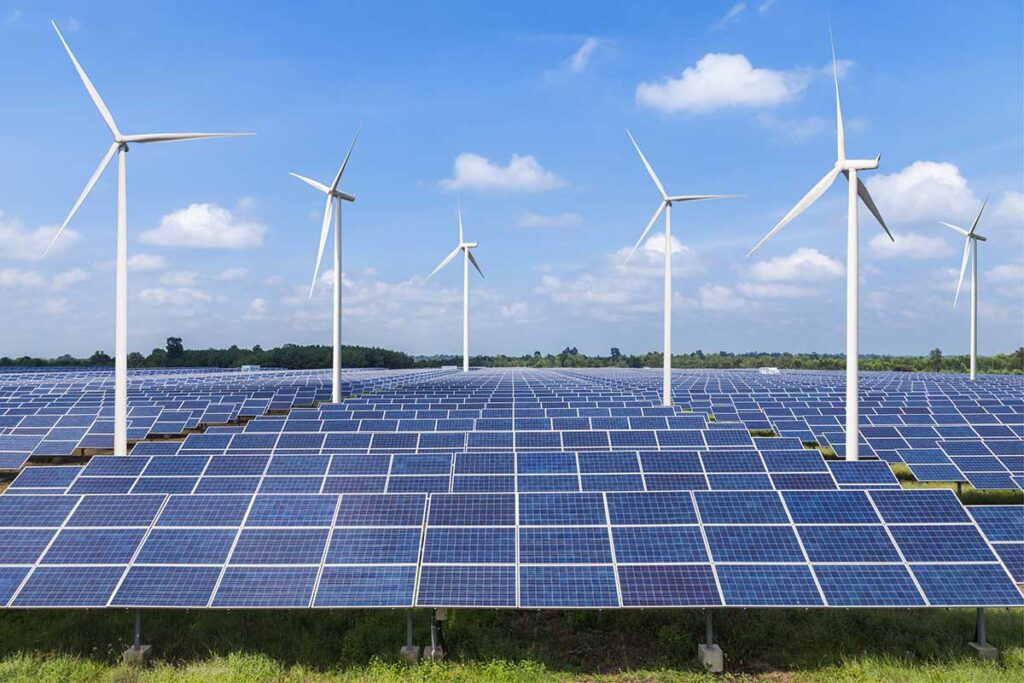
Increasing renewable energy generation while reducing coal and gas has cut average wholesale electricity costs in half according to the Australian Energy Market Operator (AEMO).
AEMO’s latest quarterly snapshot of our National Electricity Market (NEM) credits record wind, solar and battery storage penetration as being the key driver behind the 47% average cut to wholesale energy prices.
Renewables supplied over 42% of our power needs between April and June, up from 37% year-on-year. Meanwhile, coal generation dropped by 5% and gas generation by a massive 30% to its lowest Q2 average since 2003.
Smart Energy Council Chief Executive David McElrea says the year-on-year figures are unambiguous proof that increasing renewable energy while reducing coal and gas is cutting electricity costs.
“The trend is clear, the more clean energy generation and less polluting fossil we have in the grid is not only slashing power bills, it’s securing system reliability and cutting emissions.”
“Renewable energy is delivering an average cut of almost 50 per cent to wholesale electricity costs, that’s good news for households, businesses and our climate.”
The Smart Energy Council says the report delivers a clear lesson for policymakers still pushing gas as the answer to energy affordability: the single biggest driver of lower domestic gas prices this quarter was falling demand. AEMO’s domestic wholesale gas price fell to $9.08/GJ, its lowest level since Q2 2021, because Australians used less gas for power generation and heating, even as LNG exports hit a record high.
“Renewables are delivering a triple dividend; they’re pushing expensive gas out of the system, meaning we’re using less of it, making it cheaper,” Mr McElrea said.
“Electrification alternatives to coal and gas are now so mainstream they are lowering energy costs for all. The evidence clearly shows this trend will continue.”
AEMO’s Quarterly Energy Dynamics report shows a 20% year-on-year generation increase for wind, 12% for grid-scale solar and 6.9% for rooftop solar (+6.9%). That coupled with a doubling of grid-scale battery capacity exceeding 9 gigawatts (GW), and a 41% increase in household battery capacity equalling 3,283 megawatt hours (MWh).
“The Albanese Government can rightfully take credit for these results, particularly Energy Minister Chris Bowen,“ Mr McElrea said.
“It is clear that energy and climate policy is headed in the right direction, and delivering measurable outcomes, but we cannot slow down.”
-ENDS-
Media Contact
Email: media@smartenergy.org.au
Phone: +61 448 972 192
Website: www.smartenergy.org.au
About the Smart Energy Council
The Smart Energy Council is the peak independent membership body representing Australia’s renewable energy industry. We are a not-for-profit organisation and registered charity, advocating on behalf of our members and the wider industry for strong energy policy, increased investment, energy security and sustainable industry growth. Our work spans residential, commercial and industrial distributed energy resources (DER), including solar PV and battery storage, rooftop solar, electrification, electric vehicles and smart transport, renewable manufacturing, large-scale renewable energy, electricity grid development and emerging energy technologies. We represent our members’ interests nationally and internationally, including across the Asia-Pacific region.
If your organisation operates in the renewable energy sector, become a member to support our work, strengthen our collective voice and help shape the industry’s future.
Share on socials