

Media Coverage

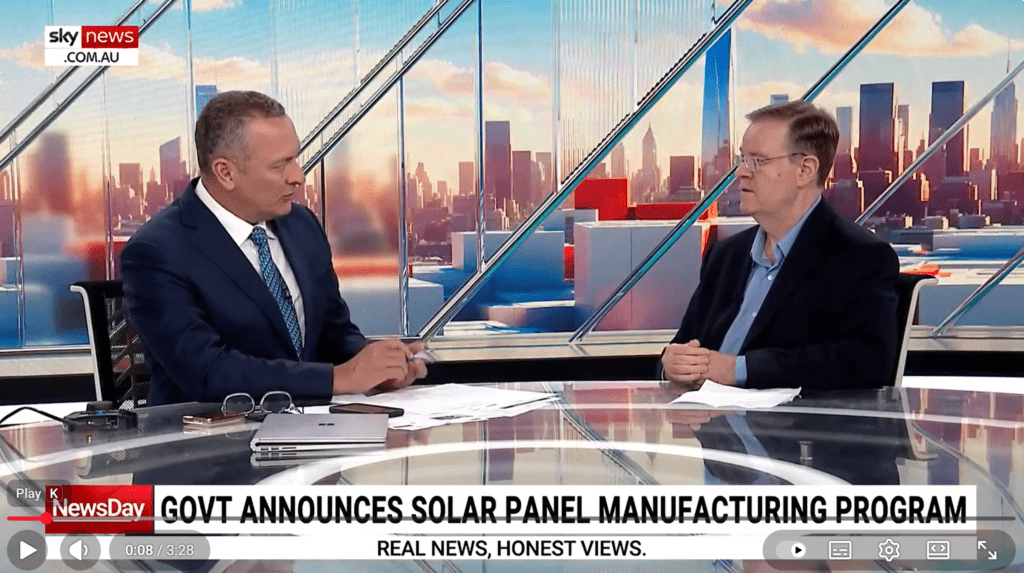
John Grimes Speaks on Australia’s renewable energy transition with Sky News

The video discusses Australia’s renewable energy transition, the role of nuclear power, and the future of electric vehicles (EVs).

Renewable Energy Investment and Challenges

Investment in utility-scale renewables dropped significantly from $6.5 billion in 2022 to $1.5 billion in 2023. The previous policy driving renewables, the Renewable Energy Target, ended in 2020. In 2023, the government implemented the Capacity Investment Scheme to build 34 GW of new renewables and energy storage, which is about half of Australia’s total generation fleet. This is a major construction effort planned between the present and 2030.

Challenges in the renewable energy transition include:

Slow Planning Process: In places like New South Wales, the planning process for projects such as wind farms can take over three years for approval. This delay is considered insufficient for a transition needing speed and scale.

Transmission Lines and Social License: Managing the “social license” is critical, particularly concerning transmission lines through farming and regional areas where communities may not want them.

Community Engagement: The industry must engage with communities and offer benefit-sharing, such as lower electricity rates for hosting the infrastructure. Solar and wind power are variable and require a buffer of storage, like pumped hydro storage (e.g., Snowy 2.0) and big batteries, to make power available on demand for the entire economy.

Nuclear Power: While nuclear power is an “amazing technology” relied upon in places with little land and no renewable resources, it “really doesn’t make much sense” for Australia. Nuclear power is projected to come online in the late 2030s. It is considered the most expensive option, costing approximately $350 per megawatt hour, compared to $45 per megawatt hour for solar and wind. Building a nuclear power plant could cause power bills to triple or quadruple in price.

Electric Vehicles (EVs) The transition to EVs is expected to happen “quicker than people think”. New technology entering Australia could allow for charging a vehicle to almost 700 km of range in 10 minutes. Battery swapping technology is also available. The cost of EVs is decreasing and is expected to “push the old petrol cars” out of the market. The government is planning to double the capacity of superchargers/fast chargers over the next year.


Related Posts

Smart Energy South Australia 2026 showcases the state’s leadership as Australia’s renewable energy powerhouse

Smart Energy Council Visits Tindo Solar Ahead of Smart Energy South Australia

Smart Stewardship

Chair: Darren Johannesen

Meeting Frequency: Every 12 Weeks

Sector Scope

  • Recyclers
  • PV Manufacturers
  • Product stewardship participants

Policy Scope

  • Stewardship policy
  • Recycling frameworks
  • Circular economy initiatives

Technology Scope

  • Solar
  • Batteries

Topics Scope

  • Recycling pathways
  • Product stewardship schemes
  • End-of-life management
  • Industry obligations
  • Sustainability initiatives

Smart Global

Chair: Robert Potter

Meeting Frequency: Every 12 Weeks

Sector Scope

  • Importers
  • Exporters
  • Investors
  • International projects

Policy Scope

  • International trade
  • Market entry
  • Export facilitation
  • Trade Tariff 

Technology Scope

  • Smart energy technologies
  • Climate technologies

Topics Scope

  • Renewable Energy Council Asia Pacific
  • Export opportunities
  • Trade missions
  • Global Climate
  • International partnerships
  • Investment opportunities

Smart Transport

Chair: Rhiannon Evans

Meeting Frequency: Every 12 Weeks

Sector Scope

  • Transport technology providers
  • Light and Heavy Electric Fleet operators
  • Charging infrastructure businesses

Policy Scope

  • EV policy
  • Charging infrastructure
  • Transport electrification
  • Network integration
  • Incentives 

Technology Scope

  • Electric vehicles
  • Charging infrastructure
  • Fleet technologies
  • Distribution Network

Topics Scope

  • Rapid Expansion
  • Interconnections
  • Regulations and Standards
  • V2X

Smart Manufacturing

Chair: Rod Scott

Meeting Frequency: Every 12 Weeks

Sector Scope

  • Local manufacturers
  • Technology developers
  • Component suppliers
  • Emerging technologies

Policy Scope

  • Supply Chain
  • R&D
  • Manufacturing Incentives
  • CEFC

Technology Scope

  • Solar
  • Storage
  • Electronics
  • Software
  • Critical materials

Topics Scope

  • Expanding local manufacturing
  • Export opportunities
  • Supply chains
  • Local content
  • Investment attraction
  • Industry capability

Smart Large-scale

Chair: Sohaib Mohammed

Meeting Frequency: Every 8 Weeks

Sector Scope

  • Large & utility scale developers
  • Asset owners
  • Investors
  • EPCs

Policy Scope

  • NEM Review
  • Capacity Investment Scheme
  • Planning Regulation

Technology Scope

  • Solar
  • Storage
  • Wind
  • Transmission

Topics Scope

  • Interconnection
  • Development
  • Financing
  • Energy Wholesaling
  • Planning Regulation

Smart Consumer

Chair: John Welch

Meeting Frequency: Every 8 Weeks

Sector Scope:

  • Installers
  • Retailers
  • Wholesales
  • Service providers

Policy Scope

  • Consumer Energy Resources (CER) Rebate programs
  • Accreditation
  • Local regulations

Technology Scope

  • Solar
  • Battery storage
  • Energy retail
  • Distributed network technologies

Topics Scope

  • Compliance obligations
  • Training and workforce issues
  • Regulations 
  • Consumer protection
  • Energy retail developments
  • Virtual Power Plants (VPP)
  • Industry best practice

Contact Thornton de Voy

Contact Yuan Fang

Contact Ivan Chelvathurai

Contact Nigel Morris

Contact Charlie Caruso

Contact Allen Edwards

Contact Darren Johannesen

Contact Jessica Hampshire