
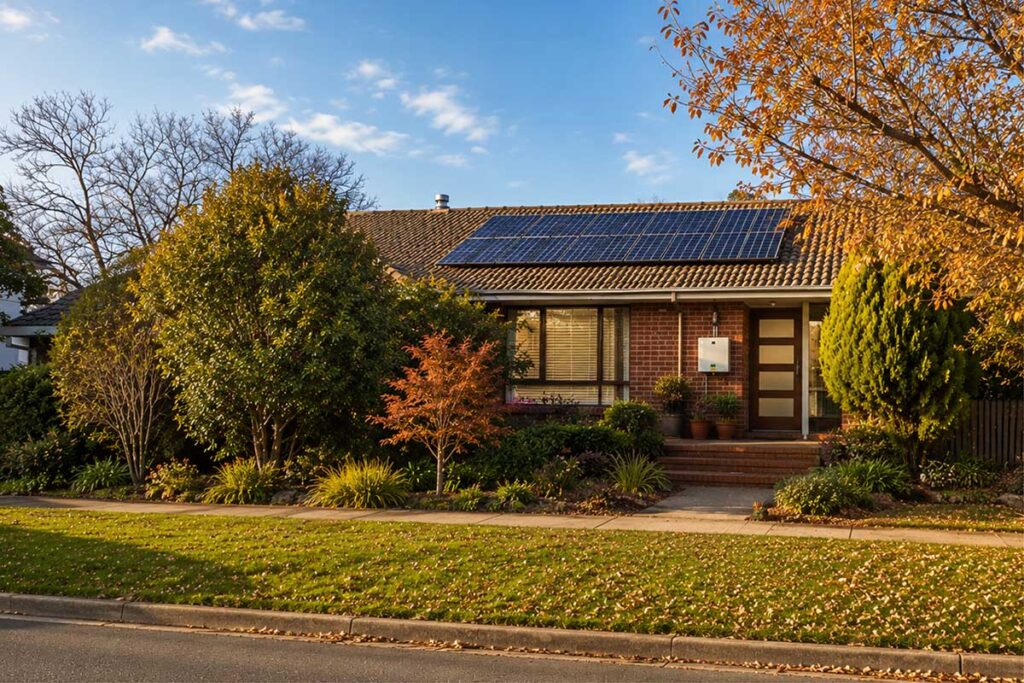
Australia’s 4.5 million solar homes have not only permanently slashed their own power bills, they are delivering measurable cuts to energy costs for every single consumer on the national grid.
This is a key takeaway from the Australian Energy Market Operator’s (AEMO) newly released 2026 Integrated System Plan (ISP), which has been strongly welcomed by the Smart Energy Council.
The landmark report confirms that solar and wind – combined with a massive boom in household and utility-scale batteries – remain the absolute lowest-cost, secure pathway for Australia’s energy future, as the nation surpasses 50 per cent renewable energy generation.
Smart Energy Council Chief Executive Officer, David McElrea, said Australian families are effectively supporting the modern grid.
“AEMO’s ISP confirms what we have long been celebrating: Australian households are at the forefront of securing our shift to renewable energy,” Mr. McElrea said.
“The impact of over 600,000 home batteries, working alongside utility-scale storage, is having a profound and measurable impact. This consumer-led energy revolution is actively reducing transmission pressures and driving benefits across the entire grid.”
The ISP highlights a massive economic incentive for moving quickly. According to AEMO’s step-change scenario, a $6b investment in transmission infrastructure will save consumers nearly $30b in net benefits by avoiding expensive additional infrastructure and the heavy costs of pollution.
Mr. McElrea warned that hesitating on these grid upgrades will directly penalise Australian taxpayers and businesses.
“In short, the more we delay, the more we pay,” Mr. McElrea said.
“That’s almost $30b Australians stand to lose if we prolong our reliance on expensive, unreliable, ageing, and polluting fossil fuels like coal and gas.”
“Without a continued, rapid rollout of new transmission, grid-scale investment costs will balloon by $17b and system operating costs will shoot up by $12b. This infrastructure isn’t just about generating clean energy; it’s about moving it to where it is needed most – our regional manufacturing hubs, mining centers, cities, and electrified transport networks.”
Looking ahead, the report underscores the rising potential of Virtual Power Plants (VPPs) – networks of rooftop solar and battery systems linked together – which could save consumers an additional $5b in avoided grid-scale investments between now and 2050.
The Smart Energy Council also noted key regional and sector-specific findings within the ISP:
- The Reality of Gas: AEMO confirms that the role of gas is strictly confined to a backup generation source. Its market share through to 2050 will not materially change from its current allocation of roughly 4% of the National Electricity Market (NEM). As renewables and storage scale up, gas will continue to diminish proportionally.
- Queensland’s Outlier Status: The Council notes that Queensland’s recent pivot back to over a decade of delay in coal-fired generation retirement, places the state starkly outside the broader momentum and trajectory of the NEM.
Ultimately, decarbonising homes and highways, and the wider electricity grid, is no longer just an environmental imperative, but the single most effective strategy to deliver market-wide economic benefits to all Australians.
Renewables are driving down pollution, with the emissions intensity of NEM generation falling from 0.96 to 0.59 tonnes of CO₂ equivalent per MWh since 2010.
-ENDS-
Media Contact
Email: media@smartenergy.org.au
Phone: +61 448 972 192
Website: www.smartenergy.org.au
About the Smart Energy Council
The Smart Energy Council is the peak independent membership body representing Australia’s renewable energy industry. We are a not-for-profit organisation and registered charity, advocating on behalf of our members and the wider industry for strong energy policy, increased investment, energy security and sustainable industry growth. Our work spans residential, commercial and industrial distributed energy resources (DER), including solar PV and battery storage, rooftop solar, electrification, electric vehicles and smart transport, renewable manufacturing, large-scale renewable energy, electricity grid development and emerging energy technologies. We represent our members’ interests nationally and internationally, including across the Asia-Pacific region.
If your organisation operates in the renewable energy sector, become a member to support our work, strengthen our collective voice and help shape the industry’s future.
Share on socials