
Media Coverage

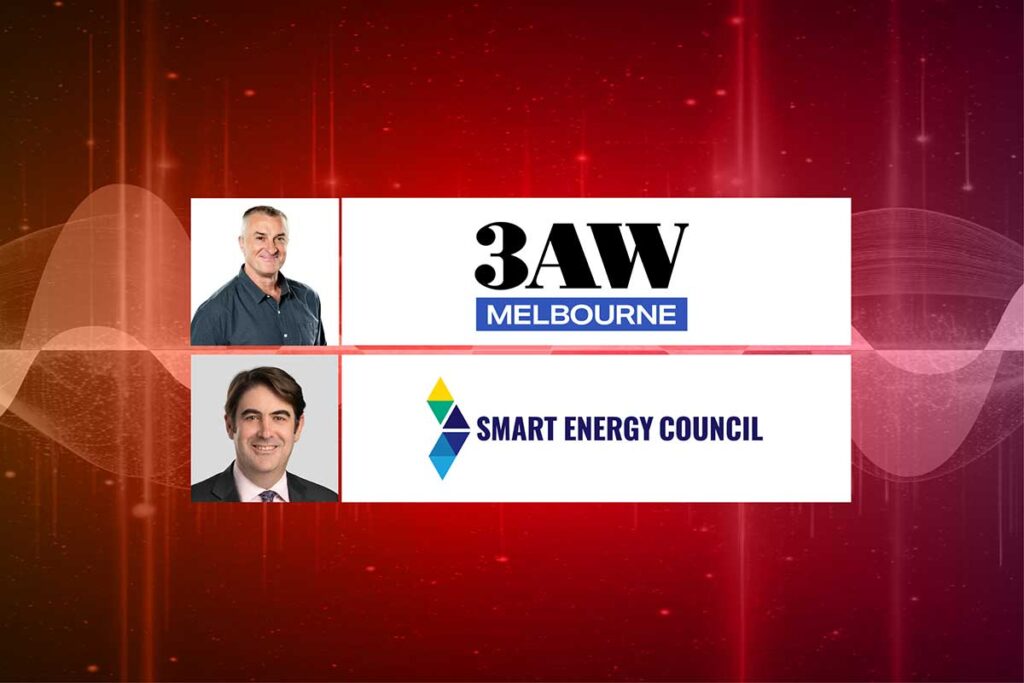
David McElrea debates waste-to-energy and Australia’s future electricity mix on 3AW Melbourne

Smart Energy Council Chief Executive David McElrea joined Tom Elliott on 3AW Melbourne for an in-depth discussion about waste-to-energy, renewable electricity and how Australia can meet growing energy demand as coal-fired power stations retire.

The interview began with the question of whether burning household rubbish to produce electricity could provide a better alternative to sending waste to landfill. David explained that the Smart Energy Council commissioned its new report, Waste-to-Energy in Australia: Energy Solution or Problem?, to scrutinise claims that waste-to-energy is renewable and low emissions.

The report finds that waste-to-energy is not renewable energy and is not a low-emissions source of electricity. David said its emissions can be close to those of coal-fired generation and higher than gas-fired generation.

The discussion also explored alternatives to both landfill and incineration. David pointed to better waste-management approaches, including separating organic materials and capturing methane through controlled processes, alongside reducing waste and recovering reusable materials before considering energy generation.

David warned that building waste-to-energy facilities with operating lives of around 30 years could lock communities into supplying rubbish to incinerators for decades. This could undermine efforts to reduce waste, improve recycling and transition towards a genuine circular economy.

The conversation broadened into a debate about Victoria’s electricity supply, the retirement of coal-fired power stations, renewable generation, transmission and battery storage. David argued that Australia’s future electricity system should be built around abundant solar and wind generation, supported by storage, a connected national electricity network and limited dispatchable backup when required.

He also stressed that coal-fired power stations are ageing, increasingly unreliable and expensive, while renewable energy remains the lowest-cost source of new electricity generation. Waste-to-energy, he said, should not distract from investment in genuine renewable energy and storage.

Read the research report here

Read the Smart Energy Council media release here

Listen to the 3AW Melbourne interview with Tom Elliott

-ENDS-

Media Contact: Tim Lamacraft, General Manager, Media & Communications
Related Posts

GenCost 2025–26 confirms renewables remain Australia’s lowest-cost pathway to net zero

Waste-to-energy in Australia: Energy Solution or Problem?

Smart Stewardship

Chair: Darren Johannesen

Meeting Frequency: Every 12 Weeks

Sector Scope

  • Recyclers
  • PV Manufacturers
  • Product stewardship participants

Policy Scope

  • Stewardship policy
  • Recycling frameworks
  • Circular economy initiatives

Technology Scope

  • Solar
  • Batteries

Topics Scope

  • Recycling pathways
  • Product stewardship schemes
  • End-of-life management
  • Industry obligations
  • Sustainability initiatives

Smart Global

Chair: Robert Potter

Meeting Frequency: Every 12 Weeks

Sector Scope

  • Importers
  • Exporters
  • Investors
  • International projects

Policy Scope

  • International trade
  • Market entry
  • Export facilitation
  • Trade Tariff 

Technology Scope

  • Smart energy technologies
  • Climate technologies

Topics Scope

  • Renewable Energy Council Asia Pacific
  • Export opportunities
  • Trade missions
  • Global Climate
  • International partnerships
  • Investment opportunities

Smart Transport

Chair: Rhiannon Evans

Meeting Frequency: Every 12 Weeks

Sector Scope

  • Transport technology providers
  • Light and Heavy Electric Fleet operators
  • Charging infrastructure businesses

Policy Scope

  • EV policy
  • Charging infrastructure
  • Transport electrification
  • Network integration
  • Incentives 

Technology Scope

  • Electric vehicles
  • Charging infrastructure
  • Fleet technologies
  • Distribution Network

Topics Scope

  • Rapid Expansion
  • Interconnections
  • Regulations and Standards
  • V2X

Smart Manufacturing

Chair: Rod Scott

Meeting Frequency: Every 12 Weeks

Sector Scope

  • Local manufacturers
  • Technology developers
  • Component suppliers
  • Emerging technologies

Policy Scope

  • Supply Chain
  • R&D
  • Manufacturing Incentives
  • CEFC

Technology Scope

  • Solar
  • Storage
  • Electronics
  • Software
  • Critical materials

Topics Scope

  • Expanding local manufacturing
  • Export opportunities
  • Supply chains
  • Local content
  • Investment attraction
  • Industry capability

Smart Large-scale

Chair: Sohaib Mohammed

Meeting Frequency: Every 8 Weeks

Sector Scope

  • Large & utility scale developers
  • Asset owners
  • Investors
  • EPCs

Policy Scope

  • NEM Review
  • Capacity Investment Scheme
  • Planning Regulation

Technology Scope

  • Solar
  • Storage
  • Wind
  • Transmission

Topics Scope

  • Interconnection
  • Development
  • Financing
  • Energy Wholesaling
  • Planning Regulation

Smart Consumer

Chair: John Welch

Meeting Frequency: Every 8 Weeks

Sector Scope:

  • Installers
  • Retailers
  • Wholesales
  • Service providers

Policy Scope

  • Consumer Energy Resources (CER) Rebate programs
  • Accreditation
  • Local regulations

Technology Scope

  • Solar
  • Battery storage
  • Energy retail
  • Distributed network technologies

Topics Scope

  • Compliance obligations
  • Training and workforce issues
  • Regulations 
  • Consumer protection
  • Energy retail developments
  • Virtual Power Plants (VPP)
  • Industry best practice

Contact Thornton de Voy

Contact Yuan Fang

Contact Ivan Chelvathurai

Contact Nigel Morris

Contact Charlie Caruso

Contact Allen Edwards

Contact Darren Johannesen

Contact Jessica Hampshire