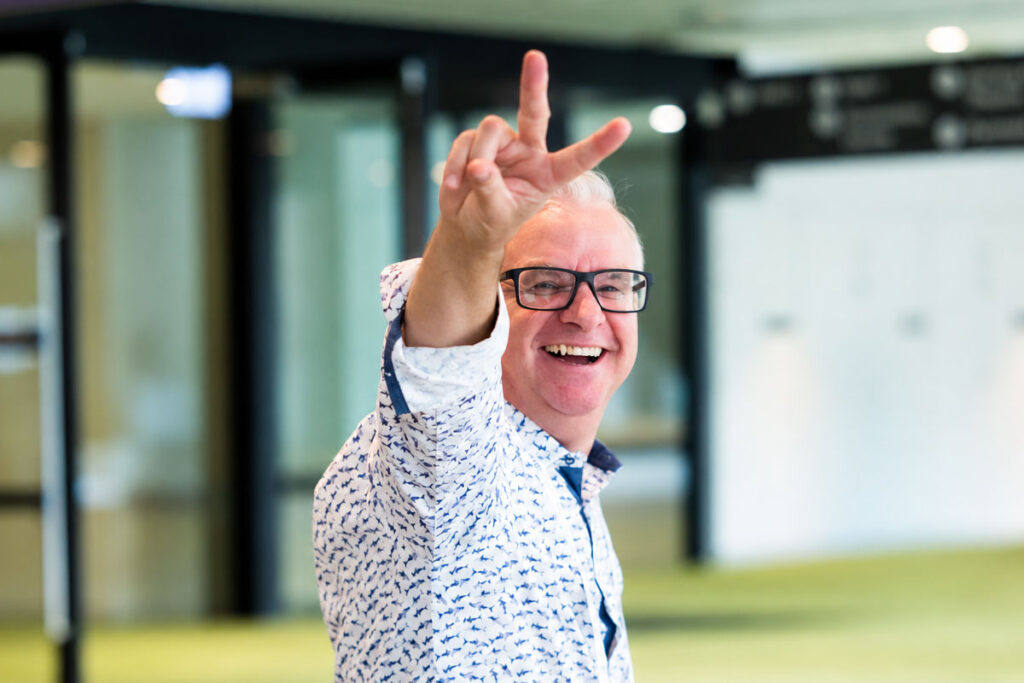

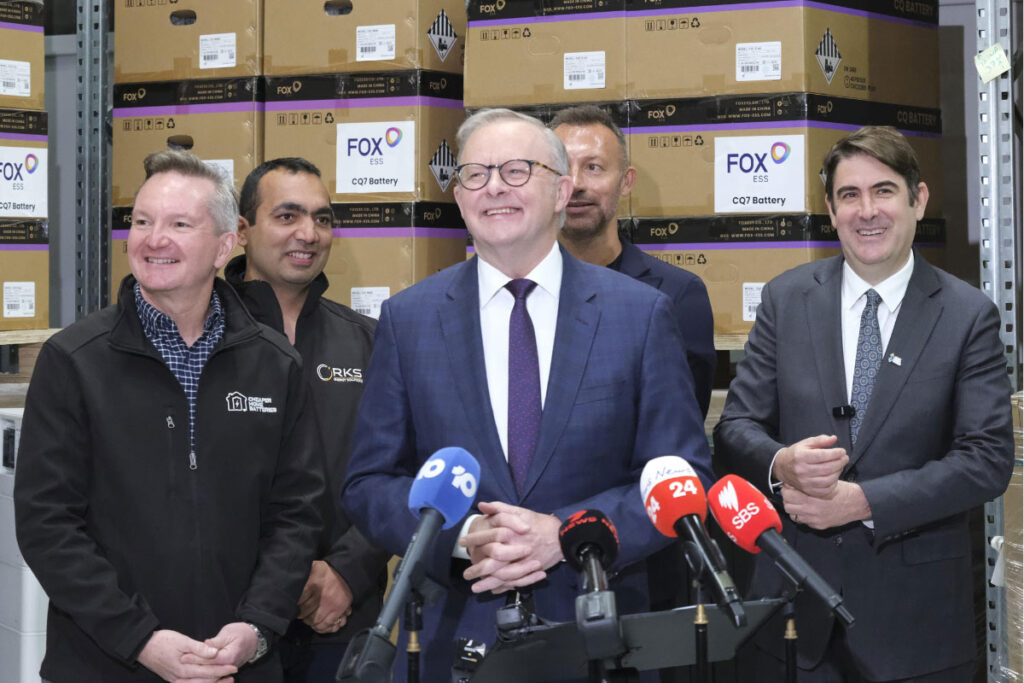
Prime Minister Anthony Albanese, Minister for Climate Change and Energy Chris Bowen, Smart Energy Council CEO David McElrea and Australian swimming legend Ian Thorpe have joined leaders from Australia’s smart energy industry in Sydney to celebrate the country passing 500,000 installed home batteries.
“Now we’re going for gold when it comes to batteries.”
That was the message from Prime Minister Anthony Albanese in Castle Hill, Sydney, as government and industry came together to mark one of the most significant milestones yet in Australia’s household energy transition.
The Prime Minister and Minister for Climate Change and Energy Chris Bowen joined Smart Energy Council CEO David McElrea, legendary Australian swimmer and Fox ESS Brand Ambassador Ian Thorpe, Smart Energy Council members and industry representatives at the warehouse of RKS Energy Solutions.
The location was fitting.
Castle Hill sits in the electorate of Mitchell, which has recorded the highest uptake of Cheaper Home Batteries in New South Wales.
According to Minister Bowen, 6,958 batteries have been installed in Mitchell, representing more than 10 per cent of households in the electorate. Mitchell has moved from 108th out of 150 electorates to third nationally for battery uptake and first in New South Wales.
A ‘great Australian story’
Prime Minister Albanese described what is happening across Australian rooftops as a “great Australian story”.
Australia is already a world leader in rooftop solar, with more than one in three Australian households having solar panels on their roofs.
Now, batteries are allowing more families to store the smart energy generated during the day and use it when they need it — reducing their reliance on electricity from the grid and putting greater control over household energy into their own hands.
The Prime Minister said the benefits also extend well beyond the households installing batteries.
“The good news story here is that not only when someone has a battery to store energy do they put down their own power bills, because it’s taking pressure off the grid, it’s bringing down everyone’s power as well,” Prime Minister Albanese said.
He described the Cheaper Home Batteries Program as an “extraordinarily successful scheme”.
“It’s creating jobs. It’s creating economic activity, reducing power bills, and making a difference to climate change by reducing our emissions. So this is an absolute win-win,” he said.
The Prime Minister also highlighted the strong uptake of the program in Australia’s outer suburbs and regional communities, where households are increasingly using batteries to store the solar energy generated on their roofs.
‘A story of global significance’
Minister Bowen said the scale of Australia’s household battery transformation now had global significance.
Australia has approximately 14 gigawatt-hours of household battery storage, compared with around nine gigawatt-hours in the United States, despite the United States having around 12 times Australia’s population.
Australia also now has more home batteries than the United States, the Minister said.
“This is a story of global significance of what Australian households have achieved,” Minister Bowen said.
The pace of the rollout has accelerated dramatically, with approximately 2,000 batteries now being installed every working day across Australia.
“Half a million, which is a remarkable national achievement. The Albanese Government and households right around Australia working together to reduce their bills — the bills for everyone, as the PM said — and reduce emissions at the same time,” Minister Bowen said.
Minister Bowen said households were in some cases reducing their electricity bills to zero, while some were receiving credits rather than paying a bill.
He also pointed to the broader impact of distributed solar and storage on the electricity market, saying it had been a major factor in wholesale energy prices falling by 47 per cent over the previous 12 months.
Jobs, apprentices and Australian businesses
The battery boom is also translating directly into jobs and business growth.
That story was on display at RKS Energy Solutions itself.
Minister Bowen said RKS had grown from nine employees to 21 following the introduction of the battery policy.
“It’s so great for jobs,” Minister Bowen said.
“Here at RKS, they used to have nine staff, and now they have 21, all as a result of the battery policy.”
Across the country, thousands of Australians are now working in the rapidly expanding battery industry, while a new generation of apprentices is gaining skills that will support Australia’s energy transition for decades to come.
The Smart Energy Council’s latest figures show the number of accredited battery installers has doubled to 8,846 since the program commenced.
Australia is also approaching 30,000 apprentices embarking on training through the clean energy stream of the New Energy Apprenticeship program.
Smart Energy Council welcomes the milestone
Smart Energy Council CEO David McElrea congratulated the Albanese Government on the success of the Cheaper Home Batteries Program and described reaching half a million batteries as an extraordinary achievement.
The Smart Energy Council has worked closely with government and industry to advocate for policies that make battery storage more affordable and accessible for everyday Australians.
Mr McElrea said the results were now being seen in Australian homes, small businesses and communities across the country.
“Most importantly, it’s helped with the cost of living, driving down power bills for Australian households,” Mr McElrea said.
He said batteries were also giving households greater control over their energy, strengthening the electricity grid and supporting thousands of jobs throughout Australia’s smart energy industry.
The Smart Energy Council will continue working with government and industry to build on the success of the program and ensure more Australians can access the benefits of solar and battery storage.
Ian Thorpe: batteries are ‘part of the solution’
Australian swimming legend and Fox ESS Brand Ambassador Ian Thorpe brought an appropriate perspective to a day when Australia was talking about “going for gold”.
Thorpe said household batteries increasingly made both practical and economic sense for Australian families.
Against the backdrop of cost-of-living pressures, he described household storage as “part of the solution”.
Thorpe also highlighted the energy security and peace of mind batteries can provide households, including the ability to store their own energy and make better use of the solar power generated at home.
“It makes economic sense,” Thorpe said.
He welcomed the progress already made and said he was interested to see what more could be done to support Australian homes and businesses to access the technology.
Industry at the table
The event also brought together Smart Energy Council representatives and member companies helping deliver Australia’s battery transformation on the ground.
Joining CEO David McElrea were Smart Energy Council Chief Strategy Officer Nigel Morris, General Manager, Media and Communications Tim Lamacraft, and Senior Advocacy and Policy Officer Rhiannon Evans.
Smart Energy Council Executive Member Fox ESS was represented by CEO Michael Zhu, alongside Fox ESS Brand Ambassador Ian Thorpe.
The event was hosted by Kunal Kapoor and the RKS Energy Solutions team, a Smart Energy Council member and a business experiencing firsthand the rapid growth of Australia’s household battery market.
Smart Energy Council Executive Member SolarJuice was also represented by Rami Fedda, Andrew Burgess and Matt Gye.
Their presence reflected an important part of the 500,000-battery story: behind every installation is an industry of manufacturers, distributors, retailers, installers, electricians, apprentices and Australian businesses turning policy ambition into real energy savings for households.
Going for gold
Australia’s 500,000 home battery milestone is not an end point.
With world-leading rooftop solar penetration, rapidly growing battery adoption and thousands of additional systems being installed each week, the opportunity ahead is enormous.
For Australian households, it means greater control over the energy they generate and use.
For the electricity system, it means more distributed storage and greater flexibility.
For Australian businesses and workers, it means jobs, investment and an industry growing to meet extraordinary demand.
And for Australia, it means another step towards a smarter, more resilient and increasingly home-grown energy system.
Australia went big on rooftop solar.
Now, as the Prime Minister said, we’re going for gold on batteries.
ENDS.
Media Contact
Email: media@smartenergy.org.au
Phone: +61 448 972 192
Website: www.smartenergy.org.au
About the Smart Energy Council
The Smart Energy Council is the peak independent membership body representing Australia’s renewable energy industry. We are a not-for-profit organisation and registered charity, advocating on behalf of our members and the wider industry for strong energy policy, increased investment, energy security and sustainable industry growth. Our work spans residential, commercial and industrial distributed energy resources (DER), including solar PV and battery storage, rooftop solar, electrification, electric vehicles and smart transport, renewable manufacturing, large-scale renewable energy, electricity grid development and emerging energy technologies. We represent our members’ interests nationally and internationally, including across the Asia-Pacific region.
If your organisation operates in the renewable energy sector, become a member to support our work, strengthen our collective voice and help shape the industry’s future.
Share on socials