
Australia passing 500,000 installed home batteries is about much more than a number. Smart Energy Council CEO David McElrea says it is helping cut household power bills, create Australian jobs, grow small businesses and give families greater control over their energy – while strengthening Australia’s energy, economic and national security.
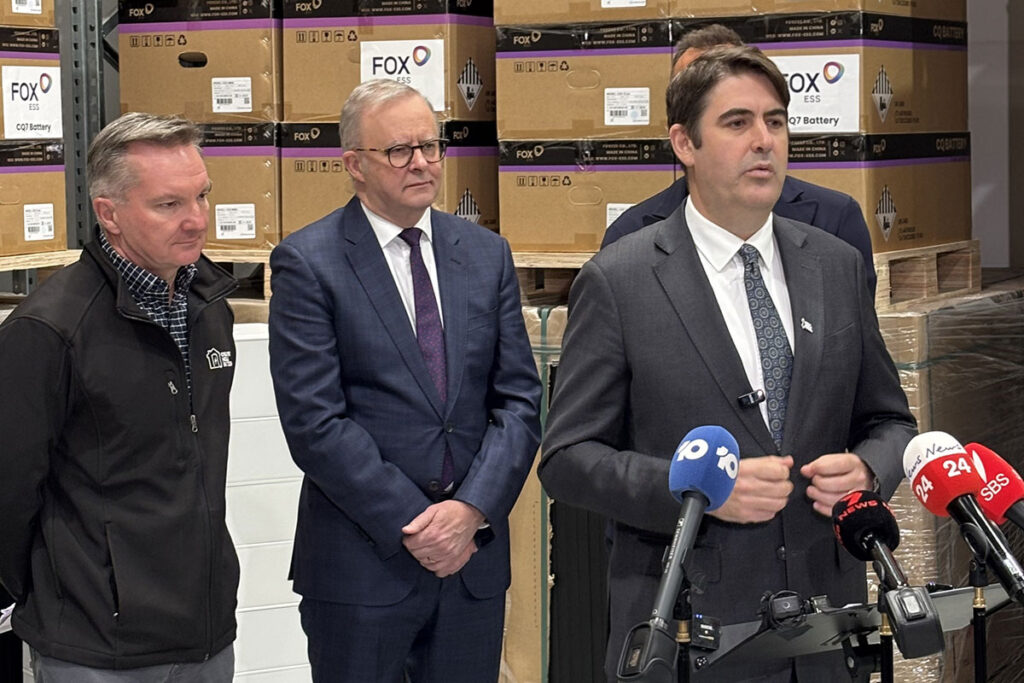
Standing alongside Prime Minister Anthony Albanese and Minister for Climate Change and Energy Chris Bowen in Castle Hill, Sydney, Smart Energy Council CEO David McElrea had a simple message about the extraordinary growth of solar and batteries across Australia.
“Aussie energy for Aussie families.”
Mr McElrea was speaking as government, the Smart Energy Council and industry gathered at RKS Energy Solutions to celebrate Australia passing 500,000 installed home batteries
For the Smart Energy Council, the milestone represents the real-world outcome of sustained work between government, industry and households to unlock one of Australia’s greatest energy opportunities.
The Smart Energy Council has worked closely with government and industry to advocate for policies that make battery storage more affordable and accessible, including the Cheaper Home Batteries Program.
Mr McElrea congratulated the Albanese Government on the program’s success.
“It’s an extraordinary achievement to roll out half a million batteries in this time,” he said.
But behind that headline number are hundreds of thousands of individual Australian households — and that, Mr McElrea said, is where the real significance lies.
Cutting household power bills
At a time when cost of living remains front of mind for Australian families, Mr McElrea said one of the most important outcomes of solar and battery adoption was the ability to permanently reduce household energy costs.
“Most importantly, it’s helped with the cost of living, driving down power bills for Australian households,” he said.
“If you buy solar and a battery, your bill can decrease by as much as $2,000 a year.”
A household battery allows families with rooftop solar to store electricity generated during the day and use it later when they need it.
That means households can make greater use of the energy produced on their own roof rather than purchasing electricity from the grid at other times.
But Mr McElrea stressed that the benefits do not stop with people who own a battery.
“As the Prime Minister said, it also helps all Australians. It reduces all bills for Australian families,” he said.
As more distributed battery capacity enters the system, households can help reduce pressure on the electricity grid and contribute to a more flexible and resilient energy system.
Energy independence in Australian hands
For Mr McElrea, batteries are also about something increasingly important: control.
“It also gives people energy independence and control over their energy supply,” he said.
Australia already has one of the highest rates of rooftop solar adoption in the world.
Combining that enormous distributed generation resource with household storage means Australians can increasingly generate, store and manage their own electricity.
And at the Castle Hill event, Mr McElrea connected that household transformation to a much bigger national conversation.
‘Aussie sun is the best sun in the world’
Mr McElrea said Australia’s investment in smart energy has important implications not only for electricity prices and emissions, but for the country’s energy, economic and national security.
His argument is straightforward: Australia has an extraordinary domestic energy resource available every day on rooftops across the country.
It should use it.
“Aussie sun is the best sun in the world,” Mr McElrea said.
“We should be growing our energy here to protect ourselves from energy shocks abroad.”
Australia has historically been exposed to movements in international fossil fuel markets and global energy supply disruptions.
Rooftop solar and batteries offer a fundamentally different proposition — energy generated by Australian households, on Australian rooftops, stored in Australian homes and used by Australian families.
“Aussie energy for Aussie families,” Mr McElrea said.
“Every solar panel that we put on a roof helps shield Australian households from the impacts of global energy crisis, global energy supply shocks.”
With hundreds of thousands of rooftops generating electricity even through an Australian winter, Mr McElrea said the opportunity to build greater domestic energy resilience was sitting in plain sight.
Australians are backing the battery boom
The rapid adoption of batteries is being accompanied by strong public support.
New YouGov polling commissioned by the Smart Energy Council and released alongside the milestone found:
-
- 75 per cent of Australians support the Australian Government’s Cheaper Home Batteries Program.
-
- 66 per cent believe government support helping households install home batteries is a good use of public funding.
The polling surveyed 1,029 Australian voters, with fieldwork undertaken between 31 July and 5 August 2026.
Mr McElrea said those results reflected the breadth of benefits Australians were seeing from battery storage.
“With all those positives, no wonder it is so popular with the Australian community,” he said.
What was only a few years ago considered a relatively niche household technology is rapidly becoming a mainstream part of how Australians think about generating, storing and using electricity.
Building Australian businesses and jobs
The benefits are also being felt beyond household electricity bills.
Australia’s battery boom is creating work throughout the smart energy supply chain — from manufacturing and distribution through to sales, installation, electrical work and ongoing services.
Mr McElrea said thousands of jobs were being supported across the economy.
“It’s created jobs and we’ve seen some of those workers today,” he said.
Importantly, many of the businesses benefiting are Australian small businesses.
“These are often small businesses, mum and dad businesses going out, hiring extra staff, investing in Australian businesses,” Mr McElrea said.
RKS Energy Solutions, which hosted the Castle Hill event, provides a powerful example.
The business has grown from nine employees to 21 following the introduction of the battery policy, according to Minister for Climate Change and Energy Chris Bowen.
Across Australia, the number of accredited battery installers has doubled to 8,846 since the program commenced.
Australia is also approaching 30,000 apprentices embarking on training through the clean energy stream of the New Energy Apprenticeship program.
Those are skills and jobs that will be required for decades as Australia continues transforming the way it generates, stores and uses energy.
Advocacy becoming action
For the Smart Energy Council, reaching 500,000 batteries demonstrates what can happen when effective policy is matched with an industry capable of delivering it.
The Council has been a strong advocate for measures that accelerate household battery adoption and has worked with government and industry to help turn that ambition into action.
The result can now be seen on rooftops, garages and homes across Australia.
It can be seen in households paying less for electricity.
It can be seen in small businesses hiring additional staff.
It can be seen in electricians and installers building careers.
And it can be seen in an electricity system increasingly supported by hundreds of thousands of distributed energy resources.
The Smart Energy Council believes there is considerably more to do.
As battery technology continues to improve and adoption grows, the opportunity is to ensure even more Australian households and businesses can participate — while building the workforce, businesses and policy settings required to support that growth.
Australia’s first 500,000 home batteries have demonstrated what is possible.
The next chapter is about taking those benefits even further.
As David McElrea put it:
“Aussie sun is the best sun in the world.”
And increasingly, Australians are storing that energy at home and putting it to work for themselves, their communities and the country.
Aussie energy for Aussie families.
ENDS.
Media Contact
Email: media@smartenergy.org.au
Phone: +61 448 972 192
Website: www.smartenergy.org.au
About the Smart Energy Council
The Smart Energy Council is the peak independent membership body representing Australia’s renewable energy industry. We are a not-for-profit organisation and registered charity, advocating on behalf of our members and the wider industry for strong energy policy, increased investment, energy security and sustainable industry growth. Our work spans residential, commercial and industrial distributed energy resources (DER), including solar PV and battery storage, rooftop solar, electrification, electric vehicles and smart transport, renewable manufacturing, large-scale renewable energy, electricity grid development and emerging energy technologies. We represent our members’ interests nationally and internationally, including across the Asia-Pacific region.
If your organisation operates in the renewable energy sector, become a member to support our work, strengthen our collective voice and help shape the industry’s future.
Share on socials