
November 19, 2024
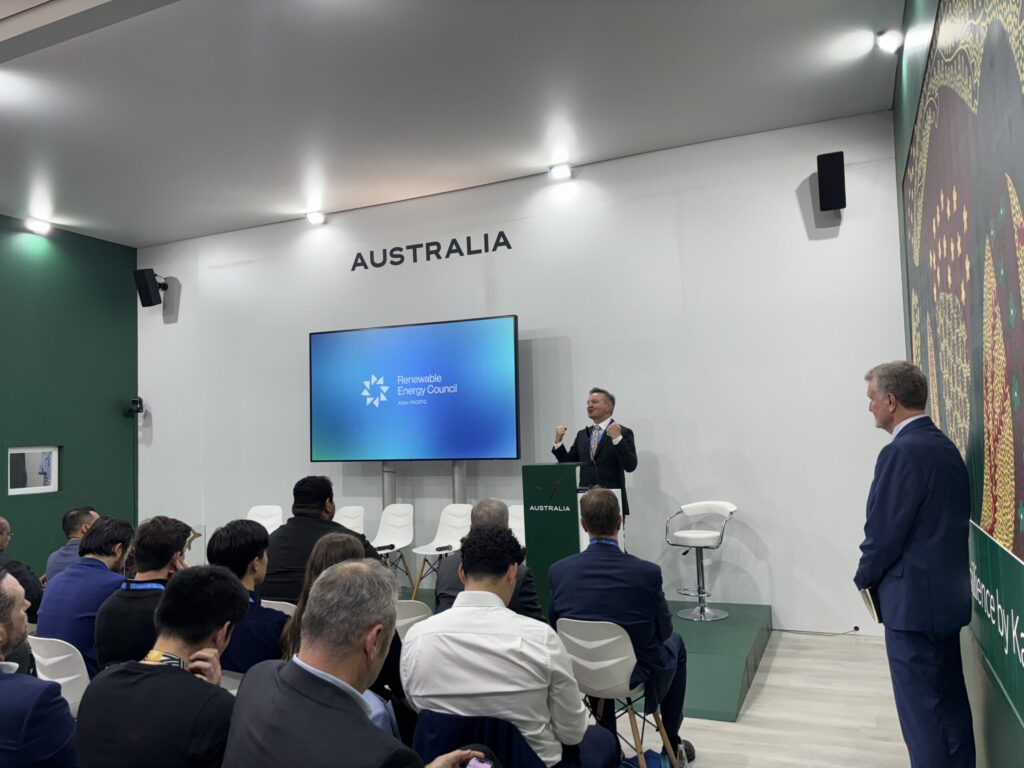
The Smart Energy Council is proud to announce the official launch of the Renewable Energy Council Asia-Pacific (RECAP), at COP29 in Baku, Azerbaijan on Monday, November 18.
John Grimes, Founder and CEO of RECAP, says the body will be instrumental in helping connect the capital and industry needed to help the region decarbonise.
“As a peak industry forum for renewable energy, APAC now has a vital hub that connects industry capability with governments and investors to accelerate climate solutions throughout the region.”
“The Asia-Pacific is the world’s leading source of greenhouse gas emissions and also a leading source of climate change solutions.”
“To accelerate and scale renewable energy, we must work together. It is only through regional collaboration that industry can deliver the energy transition at the pace required, and in an inclusive way.”
“We’re powering renewables together with local voices, local solutions and local action.”
Australia’s Climate Change and Energy Minister Chris Bowen was in Baku for the launch, where he spoke of the need for increased collaboration in our region.
“Climate change is a reality and ongoing existential threat for our Pacific nations – which is why Australia is working to strengthen energy security and accelerate the renewable energy transformation across our region.
“The Albanese Government commends the Smart Energy Council for their climate leadership to connect the capital and industry needed to help the region decarbonise.”
As the peak industry body, RECAP represents renewable energy, energy storage, renewable hydrogen, green metals, sustainable finance and low emissions transport across the region.
The economic opportunities for renewable energy in the Asia-Pacific are significant:
- Solar and offshore wind supply chain investments in Asia Pacific represent a more than US$1 trillion opportunity through to 2050, with 75% of this staying in local economies.Other system components for solar and offshore wind make up about 70% of total project spends. These represent significant commercial opportunities for domestic suppliers, manufacturers, and contractors, from now to 2050.
- Solar is already the cheapest form of electricity generation, and prices are going down. This is an immediate opportunity to not only decarbonise, but also provide local communities with affordable, equitable access to electricity. Other system components for solar and offshore wind make up about 70% of total project spends. These represent significant commercial opportunities for domestic suppliers, manufacturers, and contractors, from now to 2050.
- Offshore wind in the Asia Pacific has more than US$400 billion of potential and associated shipbuilding opportunities of up to $97 billion.Other system components for solar and offshore wind make up about 70% of total project spends. These represent significant commercial opportunities for domestic suppliers, manufacturers, and contractors, from now to 2050.
- Other system components for solar and offshore wind make up about 70% of total project spends. These represent significant commercial opportunities for domestic suppliers, manufacturers, and contractors, from now to 2050.
Harnessing our collective strengths, RECAP will:
- build business-to-business renewable energy partnerships across the Asia-Pacific
- enable discussions between industry, government and society on the renewable energy transition
- provide practical training in renewable grid integration, energy storage, best practice solar installations and moreOther system components for solar and offshore wind make up about 70% of total project spends. These represent significant commercial opportunities for domestic suppliers, manufacturers, and contractors, from now to 2050.
- tell a strong, positive story about the economic and employment opportunities from the transition to net zero in the Asia-Pacific region, and spotlight the work of governments and industry.
For more information about RECAP click here.
Media contact: Tim Lamacraft – tim.lamacraft@smartenergy.org.au – 0448 972 192