
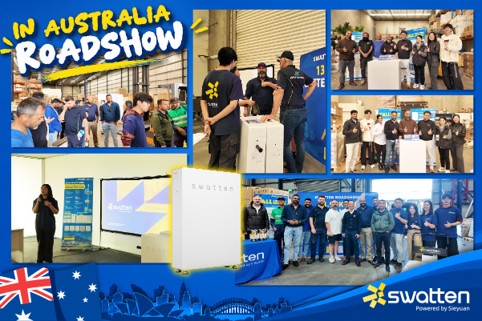
Across 15 roadshow events in Victoria, New South Wales and Queensland, more than 100 solar and battery installers explored the HQ14-F residential and commercial energy storage platform.
In September 2026, Swatten held 15 Australian roadshow events, showcasing its HQ14-F 13.99kWh high-voltage stand-alone battery system.
Swatten is a residential and commercial energy storage brand under Sieyuan Electric, which has more than 33 years of experience in power equipment manufacturing and electrical engineering.
Home battery storage in Australia and local incentives
Australia’s Cheaper Home Batteries Program makes system sizing an important consideration for households and eligible small businesses.
Since 1 May 2026, the applicable small-scale technology certificate (STC) factor has been applied at 100% to the first 14kWh of usable capacity, 60% to the portion above 14kWh up to 28kWh, and 15% to the portion above 28kWh up to 50kWh.
With 13.99kWh of usable capacity per module and 27.98kWh in a two-module configuration, the HQ14-F sits close to the first two capacity thresholds, providing installers with different system sizing options when planning home battery storage installations.
Hands-on experience across 15 roadshow events
From Melbourne to Sydney and Brisbane, installers explored the system through product demonstrations, technical discussions and hands-on installation experiences.
The sessions focused on practical project considerations including transport, available space, installation procedures and future expansion.
The roadshow gave local installers an opportunity to assess how the battery platform could fit different residential and commercial projects.
Modular system options
The HQ14-F series uses a modular configuration covering 13.99kWh to 83.94kWh of usable capacity, using lithium iron phosphate (LFP) battery cells with a stated 100% depth of discharge.
A common core battery module can be used to create six capacity configurations across the 13.99kWh to 83.94kWh range.
According to Swatten, the compact cabinet design is intended to support transport and installation across a range of residential and commercial settings. Its modular format also allows system capacity to be adjusted according to project requirements and site conditions.
Residential and commercial applications
Beyond residential battery storage, the HQ14-F can be combined with multiple inverters to create commercial and industrial (C&I) energy storage configurations.
Representative configurations provided by Swatten include:
- 100kW / approximately 168kWh: two 50kW inverters and twelve 13.99kWh battery modules
- 150kW / approximately 252kWh: three 50kW inverters and eighteen 13.99kWh battery modules
The capacities are rounded, with respective module totals of 167.88kWh and 251.82kWh.
Swatten’s modular approach allows system sizing to be adjusted according to project demand and site conditions. Depending on the installation, the configuration may also reduce the need for heavy lifting equipment and extensive civil works.
For farms, hotels, warehouses and small to medium-sized businesses, these battery storage configurations can support solar self-consumption, time-of-use energy management, peak shaving and backup power for essential loads, subject to system design and installation requirements.
Installers can discuss inverter selection, capacity and expansion options with Swatten based on individual project requirements.
Through its September roadshows, Swatten introduced Australian installers to the HQ14-F platform and its potential applications across residential and commercial energy storage projects.
For further information, visit Swatten’s website or view the company’s product video.
END